Table of Contents
Free Debt vs Invest Calculator (US) – Pay Off Debt or Invest Extra Money?
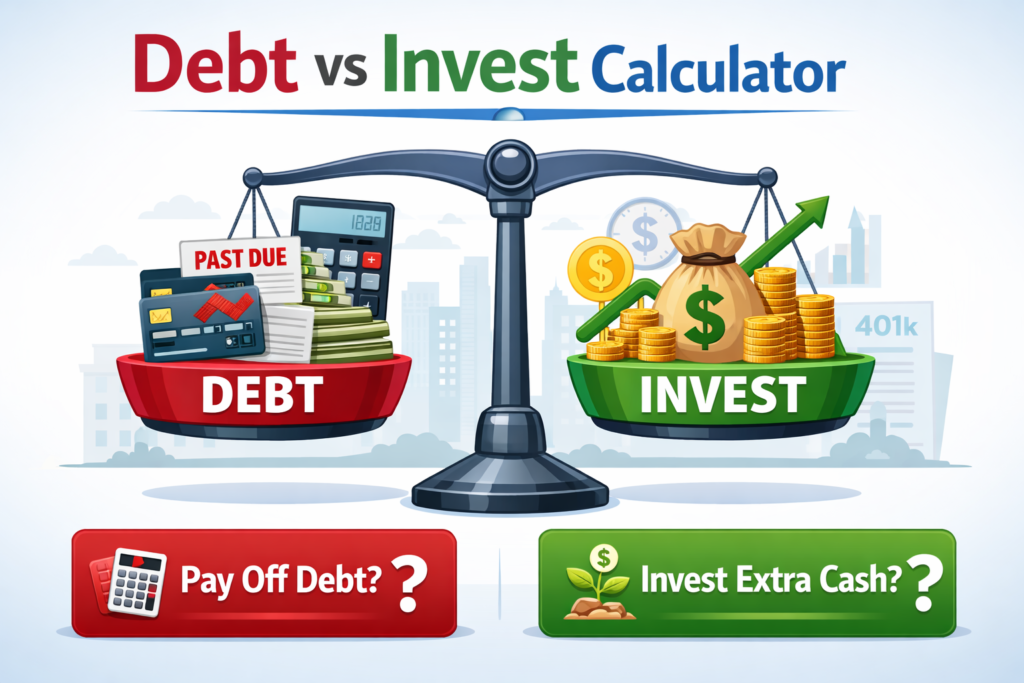
Use free Debt vs Invest calculator for US market to compare paying down debt vs investing extra cash. Includes 401(k) match, Roth vs Traditional, and taxes.
What our Tool of Debt vs Invest does?
This Debt vs Invest Calculator (Tool) simulator compares two paths for your extra monthly cash: paying down debt faster versus investing while paying only the minimum. The results are based on the inputs you provide and simplified assumptions, and are intended for educational scenario testing only.
Debt vs Invest Calculator Simulator (US)
Compare two scenarios: (A) use extra money to pay debt faster, or (B) invest the extra while paying only the minimum. Educational simulation only—no financial advice.
Inputs
US-focusedUS Add-ons (Optional)
Results
Net Worth ViewInterpretation
Enter values and click Calculate.
Net Worth Over Time
Methodology & Data Sources
This Debt vs Invest Calculator is an educational simulation designed to help users explore financial trade-offs between paying down debt and investing excess cash. The calculator uses simplified assumptions such as fixed interest rates, steady investment returns, and illustrative tax treatment to demonstrate how different choices may affect long-term outcomes.
Concepts related to consumer debt and interest costs are informed by guidance from the Consumer Financial Protection Bureau (CFPB) , which explains how interest and repayment structures can materially impact household finances.
Retirement account assumptions, including 401(k) contribution concepts and general tax treatment, are based on publicly available information from the Internal Revenue Service (IRS) .
Investment return assumptions and risk considerations align with educational resources published by the U.S. Securities and Exchange Commission (SEC) , which highlights that investing involves risk and that outcomes are not guaranteed.
Information related to interest rates and household borrowing trends is broadly consistent with data and explanations provided by the Federal Reserve .
These sources are provided for general educational reference only. InvestingLab.com is not affiliated with any government agency and does not provide financial, tax, or legal advice.
For details on assumptions and limitations, see our How It Works and Disclaimer.
Frequently Asked Questions (FAQ)
Q1. Is Debt vs Invest calculator a financial advice?
No. This is an educational simulation to help you understand trade-offs.
Q2. Why is there a tax drag option?
Taxable investing can reduce effective returns depending on dividends and realized gains. Tax drag here is a simplified assumption, not personal tax guidance.
Q3. Why doesn’t this include market crashes or volatility?
Version 1 uses steady returns for clarity. You can stress-test by using the 3% and 5% buttons. We can add volatility scenarios in a later version of our tool.
Q4. Why does high-interest debt often “win”?
Because paying it off is similar to earning a risk-free return equal to the APR avoided.
Q5. Why does high-interest debt often “win”?
Because paying it off is similar to earning a risk-free return equal to the APR avoided.